What our summer party taught us about the conditions of team building
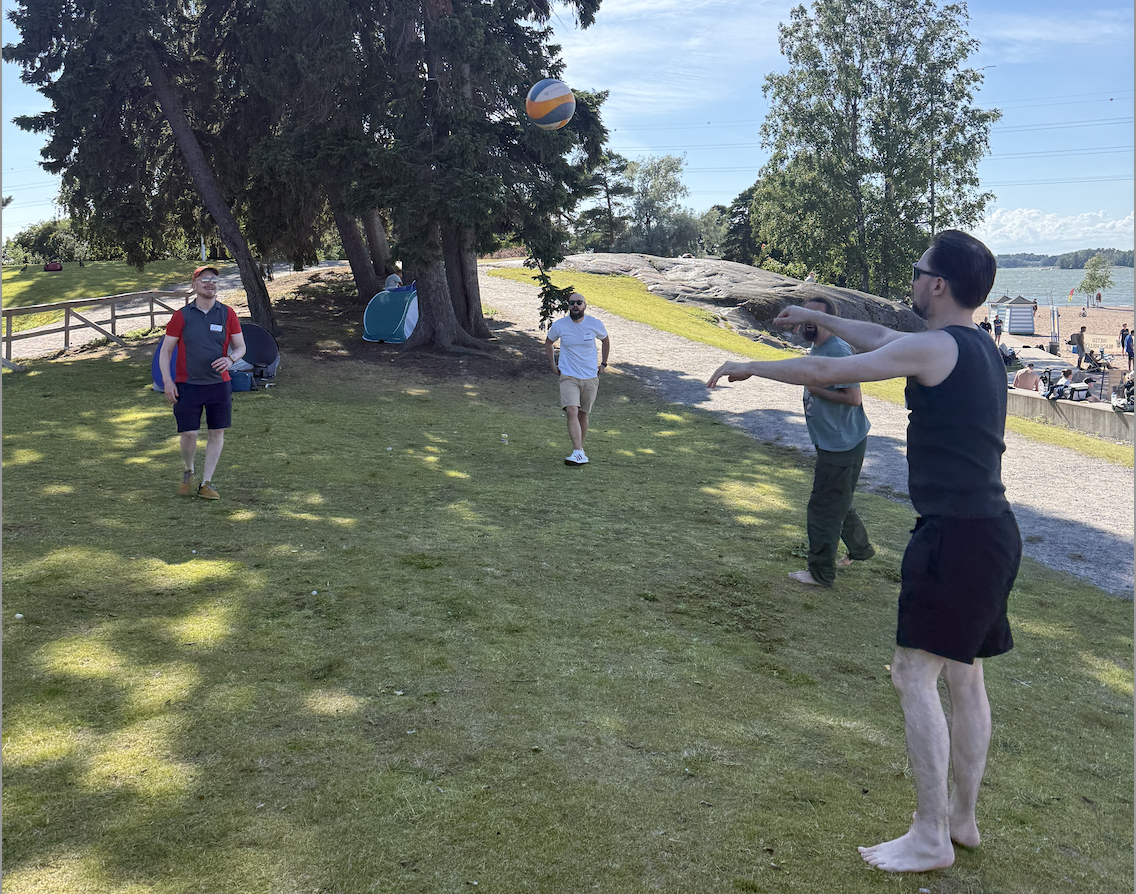
In our last Christmas party our activity showed us how people naturally slip into different roles in a team. This August we held our summer party at Hietaniemi beach playing summer games like volleyball. It was fun to see that even us sometimes shy Finns are ready to join team activities in the right kind of conditions.
From strangers to teammates
Our summer party this year (2026) was a Top Gun themed gathering including a volleyball tournament, mölkky, drinks and hanging on the beach together. One of the first comments that yours truly heard was: “I wonder if I dare to play volleyball, I played as a kid but I’m not sure if I’m good enough.” It’s the kind of slight nervousness anyone can feel entering a party without knowing anyone, especially a party with activities.
Maybe it was the sunny weather, people’s good mood, a few cold ones or the relaxed, casual atmosphere created by coolers, blankets and music that encouraged people to start throwing a ball around, thinking of how to get those mölkky blocks to fall and get into discussions with each other.
After the beach games, the party continued with a sauna, hotdogs and more great conversations. We at Thriv had a great time, and according to the feedback, so did the participants. This got us thinking: what makes a good atmosphere? It can’t be just good weather, can it…
Company culture is built in the in-between
Company culture is often described through the things that are easiest to put into words: company values, benefits, team events and the occasional afterworks. But culture is also built in all the moments that are much harder to plan or measure.
It’s in who starts talking to the new person. It’s in whether someone feels comfortable saying “I’ve never done this before”. It’s in whether you feel you are welcomed at the office in the morning by hearing “Good morning”. And it’s in the small decisions people make to include others in conversations, without being told to do so.
These moments might seem insignificant, but they can tell us a lot about how people experience a company. Do people feel comfortable enough to participate? Do they make space for different personalities? Are people willing to take a small social risk, make a suggestion or simply walk over and start a conversation?
This is especially relevant in today’s organisations, where people may work across different projects, teams and locations and of course remotely. When colleagues don't see each other every day, the informal moments can become even more important. A quick conversation before a meeting, grabbing lunch together or just laughing at a funny movie both have seen can create connections that later make collaboration feel more natural.
Maybe this is why a company party can be about more than just having fun. You can't manufacture company culture with one event, but you can create opportunities for people to get out of the usual office surroundings and find things in common outside of work. The empathy and “same page mentality” that people find between each other is a powerful force during stressful situations at work.
Creating the conditions for better teams
So, what can we actually take away from our summer party? Sure, there is no secret formula for creating a great team. But looking back at the day, there were a few things that seemed to make it easier for people to connect.
A low-pressure way to participate
Not everyone wants to be the first person on the volleyball court or the centre of attention at an event. Sometimes people just need a little time to warm up and see what is happening around them.
This is where a relaxed atmosphere can make a big difference. Our goofy hosts probably didn't hurt either. When the people organising an event aren't taking themselves too seriously, it gives everyone else permission to do the same. You don't have to be good at volleyball, know all the rules or have the perfect technique. You can just join in.
Apply the same at work. Creating a space where people don't feel like they have to perform all the time can make it easier for them to participate, share ideas and be themselves.
Shared experiences
There is something about doing an activity together that makes it easier to connect. You don't necessarily need a deep conversation starter when you are both trying to win a volleyball match or figuring out how to knock down the last mölkky block.
Shared activities give people a common experience and something to talk about. They also create small opportunities to help each other, laugh together and learn how others react to different situations.
These moments can become the little stories and inside jokes that bring people closer together long after the activity is over.
“Ice breakers”
Not every interaction needs to start with “So, what do you do?” Sometimes it's easier to start talking when there is already something happening around you.
Games, music, a sauna or a funny hot dog serving bike can give people an easy reason to start a conversation.
Inclusion as a habit
You can create opportunities for people to connect, but you can't force a friendship or manufacture a good conversation. Sometimes the best thing you can do is simply make sure people have opportunities to be around each other.
If you're already having a conversation with a couple of people and someone else comes along, invite them in. If someone is standing on their own, go and say hello.
These small gestures can make a surprisingly big difference. Being included doesn't always require a grand gesture. Sometimes it's simply someone making room for you!
Different opportunities to contribute
A team isn't built only by the loudest, most experienced or most competitive people. Good teams need different kinds of skills.
At our summer party, someone might have been the person scoring the volleyball game, someone else keeping the mölkky competition going, and someone else making people laugh. Not every contribution has to look the same.
The same is true at work. Giving people opportunities to contribute in different ways helps everyone find their place in the team. One person might lead the discussion, another might spot a problem nobody else noticed, and someone else might be the one who makes sure the quieter voices are heard.
As a last piece of information… Yes, the one who wasn’t sure about playing volleyball. He did.
Noticed a missing piece in your team? Call us!

Anna Kauppila
Marketing Coordinator
anna.kauppila@thriv.dev