Competences in a Full Product Team
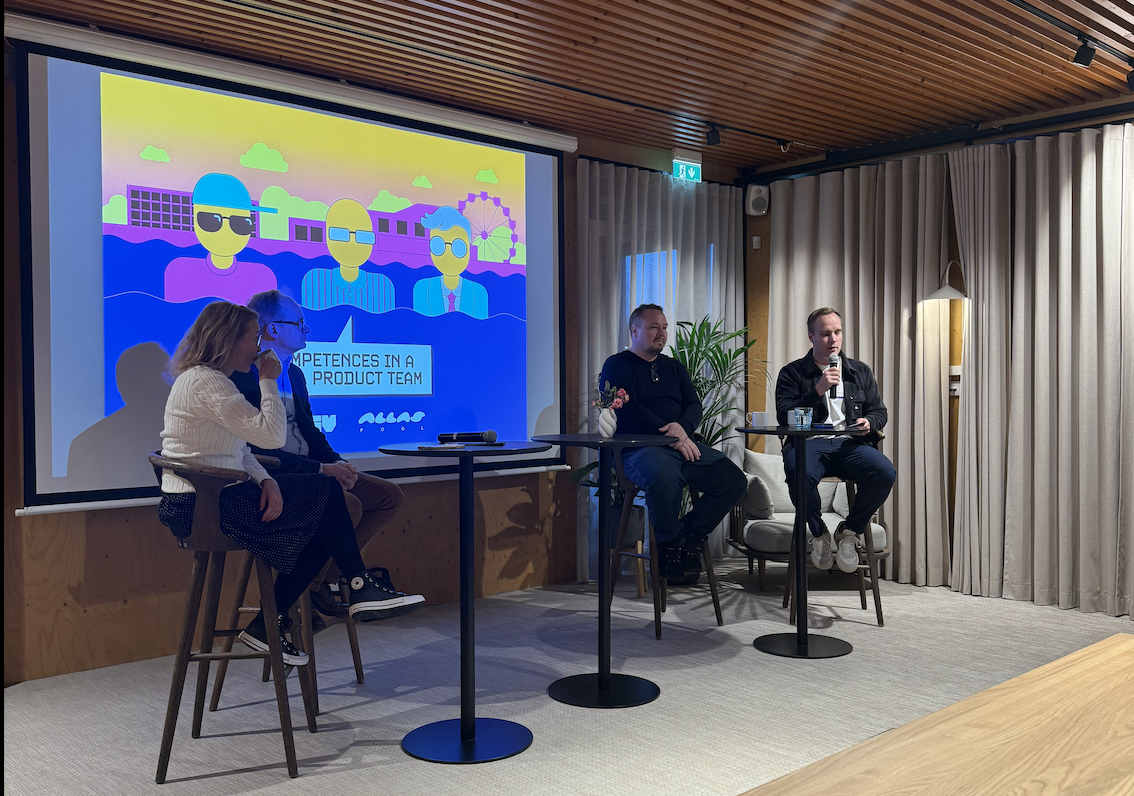
An event that has become a refreshing exchange of ideas and a dip in the ocean was held again last Fall: Our annual panel at Allas Sea Pool. This time our discussion topic was “Competences in a full product team” with panelists who seemed to have as much fun together as our audience enthusiastic about asking questions afterwards!
The panel: Eija Moisala from Elisa, Jarno Tenni from LeadDesk and Timo Harjunen from Konecranes. The facilitator: our very own Jaakko Taskisalo. And the learnings: let’s dig in.
What is a full product team?
Before getting deeper, the panel had to first figure out what a product team actually is, how it is defined, what kind of models can be used… We covered large-scale scrum and centralised DevOps, matrix and feature team setups, however in practice we could agree that it is not only about the structuring model, but what the team needs to achieve, how fast and how the personalities fit together that makes the difference.
What kind of competences are needed to make it work?
It was agreed that testing in any team is a helpful area to have, but then instead of going to the tech stacks or specialities, the panel rather talked about the importance of
- Autonomy - the team’s ability to make independent decisions
- Trust - colleagues can and will do their own part
- Personality fit - even with the most skilled professionals, having a good chemistry in the team makes things move faster
- Best talent - most suitable tech stack based on the company’s / teams goals and structure
- A company culture of open-mindedness - willingness to shift focus and look for new avenues
- Individual humility - balancing own goals with the team’s goals
- Openness to continuous learning - both in terms of AI and other skills
What does this mean regarding the future?
Yes, it’s inevitable that AI will be mentioned now. It was part of the discussion of course as well. The panelists agreed that while AI agents and peer programming can be helpful, for now AI is rather useful for smaller projects, prototypes, documentation, automation and very basic coding.
However, AI is getting better and better and this is where the panel got even more interesting: if AI can speed up the process of creating code, what kind of competences or skills should software developers hone or at least know in the future?
The traits mentioned above are something software developers, their team leads and even companies themselves can always improve on. For software developers especially, specialisation and big picture understanding including business skills were mentioned.
An excellent question from the audience introduced another big theme in terms of future skills: “How do you organise customer knowledge?” The answers were: “It is definitely a pain point.”, “We should do better in that area.”, with a grin: “Should probably focus more on since we [the whole panel] didn’t mention it at all.”, “We should definitely get POs more involved with the customer facing teams”... It was agreed that while in practice development teams might sometimes just need to push features out and test them live - finding a way to improve customer understanding is something all companies should have in mind.
As a conclusion, it’s hard to pinpoint the perfect answer to “a full product team”, but competences that fit together, a team that can make things happen, people that trust each other and are motivated to see the opportunities of AI could be a good way to start.
Missing competences in your team? Get in touch!

Anna Kauppila
Marketing Coordinator
anna.kauppila@thriv.dev